















From L0 to L3: What’s the Difference Between L1, L2, and Modern Blockchains
Modern blockchain is a multi-layer Web3 architecture made up of Layer 0, Layer 1, Layer 2, and Layer 3. These layers emerged due to the limitations of a single chain: no network can be fast, cheap, and fully decentralized at the same time. As a result, the blockchain ecosystem split responsibilities across layers - core security and consensus remain at the base, while scalability and user-facing applications are built on top, making Web3 more scalable and practical to use.

Layer 0: the foundation for creating blockchains
Layer 0 is the foundation of the blockchain architecture, responsible for core infrastructure. It provides a ready-made set of tools needed to launch and operate other networks, including consensus mechanisms, security frameworks, programming languages, SDKs, and bridges that enable interoperability between future blockchains.
Because of this, developers don’t need to build everything from scratch. The core logic is already embedded at the L0 level, which significantly simplifies and accelerates the creation of new Layer 1 networks. In practice, Layer 0 acts like a modular framework that allows teams to build custom blockchains with their own configurations.
There are only a few Layer 0 networks in practice. The most well-known examples are Cosmos and Polkadot. A similar approach also exists in Avalanche, though it is used less extensively compared to the first two. Blockchains built on top of this infrastructure typically have their own native tokens and independently define how transaction fees are paid.
As a result, Layer 0 lays the foundation for large-scale blockchain ecosystems where multiple networks can evolve in parallel while remaining interoperable with each other.
Layer 1: The main type of blockchains
The first blockchains, including Bitcoin, were designed as decentralized ledgers for recording transactions. They relied on mechanisms like Proof of Work, which provided strong security but came with clear drawbacks - low throughput and high transaction fees.
With the launch of Ethereum, blockchain gained a new dimension through smart contracts, enabling decentralized applications, DeFi protocols, and NFTs. However, this innovation introduced new challenges: as the number of users and applications grew, scaling the network without sacrificing efficiency became increasingly difficult.
Today, Layer 1 includes networks such as Ethereum, BNB Smart Chain (BSC), Solana, NEAR, Sui, Aptos, SEI, Monad, Polygon, and others.
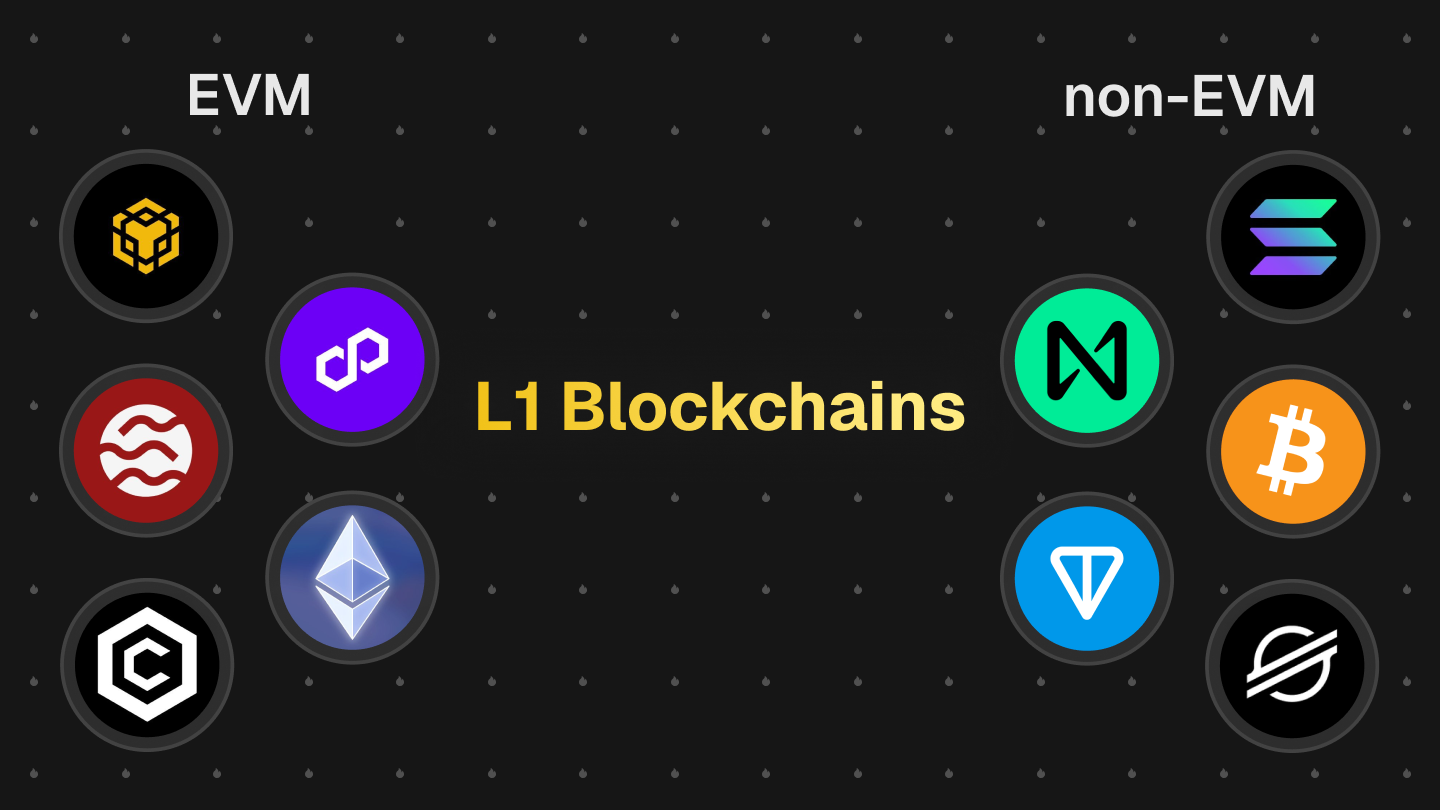
All Layer 1 networks have their own native token used to pay transaction fees (gas), but they can differ significantly from one another.
Key differences between L1 networks include:
- the consensus mechanism
- the level of decentralization
- transaction finality speed
- transaction fees
For example, Ethereum is considered one of the most decentralized networks, but it lags behind in terms of speed and cost. BNB Smart Chain (BSC), on the other hand, operates much faster, largely due to a smaller number of validators controlling the network.
In this sense, Layer 1 is the heart of the blockchain. It is where the balance between security, decentralization, and performance is defined - and that choice ultimately shapes how the entire ecosystem evolves.
Layer 2: when speed matters
Layer 2 emerged to solve a simple problem: Layer 1 networks can’t handle the load on their own. Ethereum remains one of the most battle-tested and secure blockchains, but at the base layer it was never designed for mass adoption. Significantly increasing its speed would require a complete architectural overhaul. Instead of changing the foundation, the ecosystem adopted a different approach - Layer 2 scaling solutions.
Layer 2 networks process transactions off the main blockchain, batch them together, and periodically submit the results to Ethereum for final settlement. As a result:
- transaction fees drop dramatically
- confirmations become much faster
- the security of the base layer is preserved
Even though user interactions take place on Layer 2, final settlement still happens on Ethereum, which is why transaction fees are ultimately paid in ETH. At the same time, these operations usually cost users just a few cents.
Some of the most popular Layer 2 solutions include Optimism, Arbitrum, Linea, Base, zkSync, Metis, and others. These networks have already become the foundation for many DeFi protocols and applications.
Interestingly, the Layer 2 concept is no longer limited to Ethereum. Other blockchains are beginning to adopt similar approaches, aiming to combine base-layer security with high performance and low transaction costs.
Layer 3: Specialization and Better UX
Layer 3 gives developers the ability to build products on top of Layer 1 and Layer 2 infrastructure without being constrained by their standard configurations. L3 enables the creation of environments with custom logic, economics, and rules, optimized for specific use cases.
At this level, highly specialized solutions emerge - blockchains and protocols designed for gaming, trading, NFTs, or decentralized exchanges. This approach shifts the focus away from general-purpose design toward maximum usability and performance for a particular application.
Examples of Layer 3 networks include APE Chain, Superposition, and Xai - ecosystems built for specific use cases where user experience comes first. In this way, Layer 3 represents the specialization layer, making blockchain not just technically powerful, but practical and tailored to real user needs.
Conclusion:
In practice, users don’t need to understand all the technical differences between blockchain layers if the wallet handles that complexity for them. HOT Wallet supports over 140 blockchains and provides access to all key layers of the blockchain ecosystem:
- L0, including Avalanche;
- L1 networks such as Ethereum, BNB Smart Chain (BSC), Solana, NEAR, TON, Stellar, and others;
- L2 solutions like Optimism, Arbitrum, Linea, Base, zkSync, Metis, and more;
- L3 networks, including APE Chain, Superposition, and Xai.
With built-in cross-chain bridges, users can move assets between networks quickly and with minimal fees. The gas refuel feature makes it possible to obtain the native token needed to pay transaction fees on a new network without relying on third-party services. As a result, interacting with different blockchain layers happens in a single interface - fast, secure, and without unnecessary technical steps.
One wallet. Many networks. Maximum possibilities.
Get started in 30 seconds:
Download HOT Wallet


